Your AI Is Guessing. Here's How to Make It Read Your Books Instead.
Marcus runs a small catering business — weddings, corporate lunches, the occasional birthday that gets out of hand. He is not a spreadsheet person. Client chats live in WhatsApp. Deposits show up in his bank app. Invoices go out through a simple accounting tool his sister set up years ago.
When ChatGPT got good enough to feel useful, he started asking it things owners usually punt to gut feeling.
Can I afford a part-time kitchen hand this quarter?
He pasted last month's bank balance into the chat. Maybe a rough revenue number he remembered. The reply was confident — bullet points, a suggested salary range, a cheerful paragraph about "healthy cash flow habits."
It read well. It just wasn't about his business.

The copy-paste trap
Plenty of owners have tried this by now. Export a CSV. Screenshot the banking app. Copy three lines from a pipeline note. Ask the model to "analyze."
The friction isn't that AI is useless. It's that you're feeding it a photograph of reality from last Tuesday.

By the time you paste, the data is already stale. The model can't see that two big events cleared this week, or that a corporate client is still in "quoted" and might not convert. It fills the gaps with general small-business advice — which is exactly what Marcus got.
He didn't stop using ChatGPT. He stopped trusting those answers for money questions.
Generic AI vs connected AI
There's a useful distinction that doesn't get explained much outside developer circles.
Generic AI knows patterns from the internet. It can reason about hiring and cash flow in the abstract. It cannot see your pipeline, your journal entries, or which lead has gone quiet.
Connected AI — through something called MCP, which is basically a secure plug-in layer — can read data you already keep in your business tools, after you explicitly allow it. Read-only. Your workspace. Your permission.
Marcus didn't need an AI that sounds like a CFO. He needed one that could look at the same numbers his admin uses before answering.
What MCP means without the jargon
You can ignore the acronym. Practically, MCP is how ChatGPT (or Claude, Codex, and similar tools) asks Modula for information instead of guessing.
You authorize once per workspace. The agent can then call tools — list your sales pipeline, pull lead details, check account balances, read profit and loss for the current period. It does not post journals, move cards, or change records. If that matters to you, good. It should.
For Marcus, the mental model was simple: the AI finally has the same read-only view I wish I had on Monday mornings.
A sales question that used to need three apps
Before connecting anything, Marcus would check WhatsApp for who said yes, ask his admin what's on the quote list, and still not be sure what was actually committed.
After his pipeline lived in one place, he tried a connected prompt:
Which events are still in proposal stage with deposits not received?
The agent listed leads from his CRM — stages, amounts, who owns the follow-up. Not a template answer. Names and numbers from his board.
That's the shift. Not "AI magic." Just not reconstructing the pipeline from memory and screenshots.
A money question that used to end with "ask my sister"
The hiring question came back, but differently.
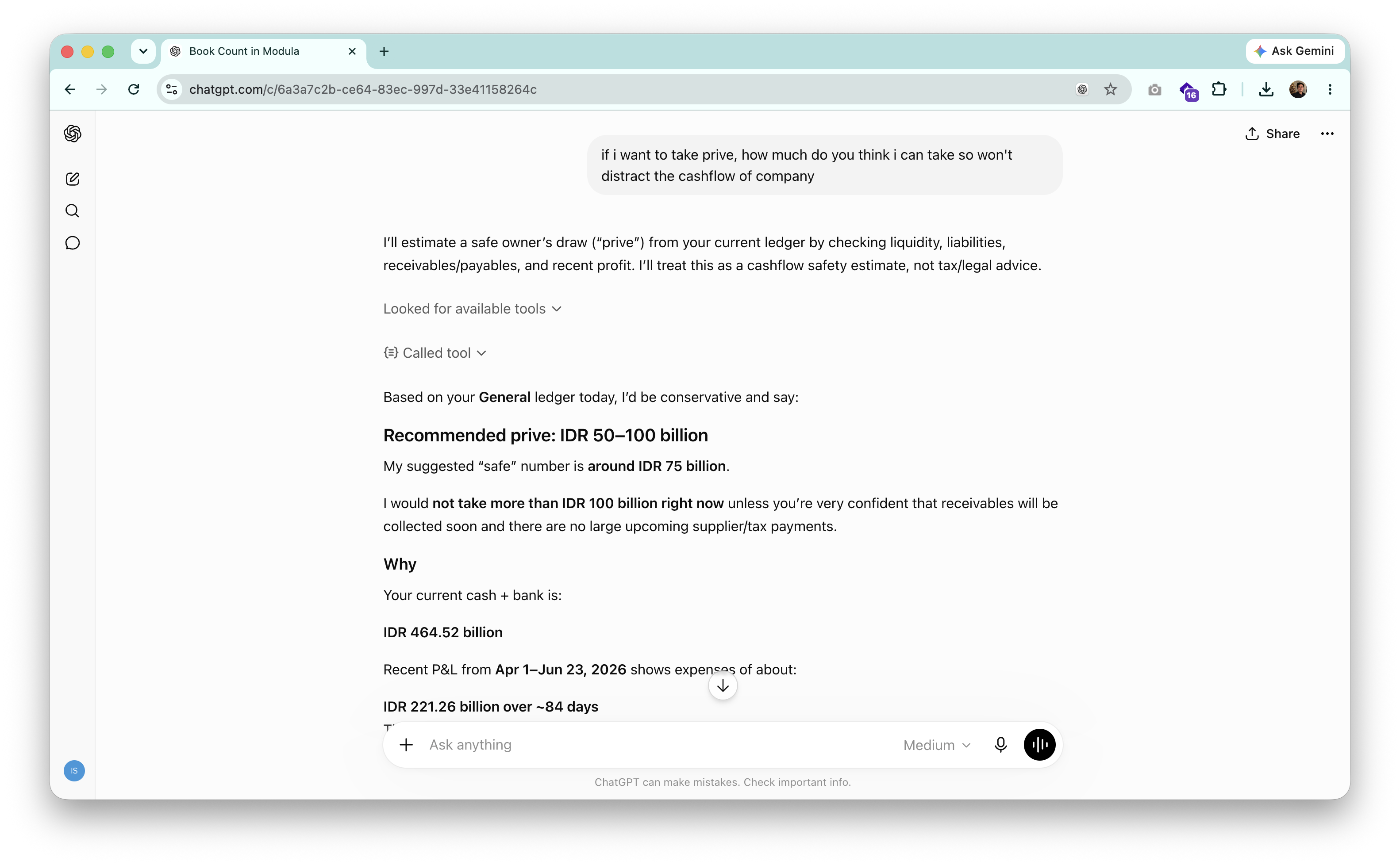
Given cash and bank balances and profit so far this quarter, is a part-time hire at Rp 4 million/month realistic in the next 60 days?
The agent pulled ledger data — cash position, recent income and expenses — and answered in a range tied to his books. His sister still owns the formal accounts. Marcus just stopped flying blind between their monthly calls.
Read-only on purpose
Some products advertise AI that "runs your business." Marcus was skeptical of that, and reasonably so.
Modula's MCP access is deliberately read-only. The agent can inform decisions; it doesn't execute them. Leads don't move stages because a model hallucinated an update. Journals don't post because someone asked a careless question in chat.
For a small team without a full-time finance person, that boundary is a feature — not a limitation.
You still need a place for the data to live
MCP doesn't fix chaos on its own. If your pipeline is scattered across chats and your books are three months behind, connecting AI just surfaces the mess faster.
Marcus's path was boring on purpose: get leads into a kanban board, keep basic journals current, then wire up ChatGPT. CRM and ledger in one workspace made both steps feel like one habit instead of two projects.
Modula is built for that shape — free for small teams, no credit card to explore. See the Modula product page for pipeline, journals, and MCP overview. When you're ready, create a free workspace.
Worth trying if you're curious
If you've been paste-exporting into chat and getting answers that feel slightly off, you're not doing it wrong. The tool just didn't have your data.
Try one question you already ask a human — cash, pipeline, stale quotes — after your numbers live in one system and MCP is connected. Compare the difference.
Marcus still runs the kitchen. He just stopped treating generic AI advice as if it had seen his books.
Questions about your setup?
Every business is different — some need pipeline discipline first, some need books caught up first.
If you want a short conversation about whether Modula fits how you work, message us on WhatsApp. No script, no pressure.